
Certificates
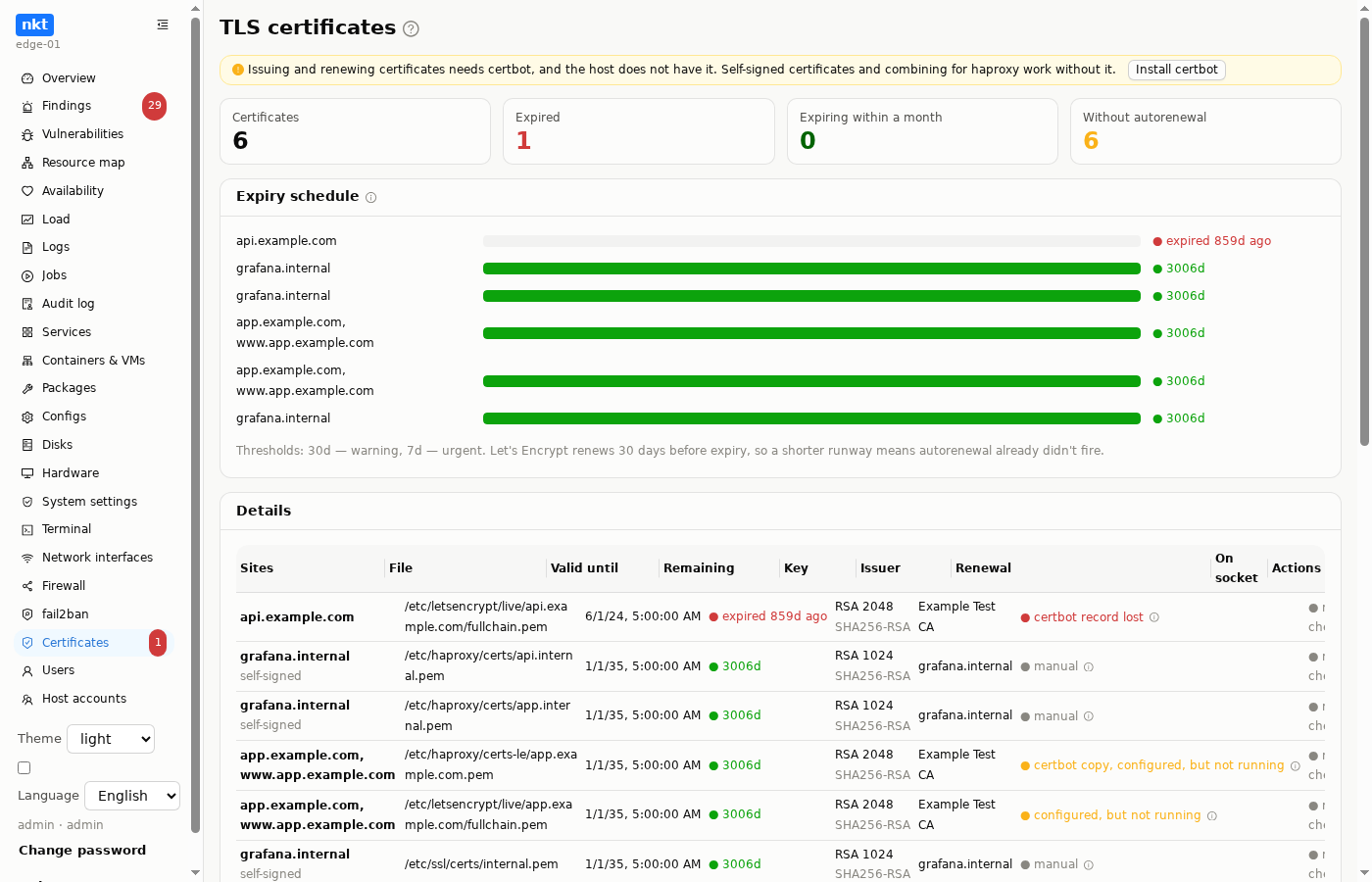
Every certificate from the nginx, haproxy, caddy configs and /etc/letsencrypt: expiry, names, issuer, algorithm, key, self-signed or not. haproxy crt directories are expanded by SNI, derived copies (the combined PEM for haproxy) are found by fingerprint and inherit the original's status.
Not just dates
- Comparison with the real socket: nkt opens a real TLS connection to the service address and compares fingerprints — the file on disk may be fresh while the service never did a
reload. A connection error is not counted as a mismatch — it's marked "not checked", so a network problem doesn't turn into a false accusation of the service. - Auto-renewal state: whether certbot knows the certificate, whether
certbot.timeror cron is active. An expired certificate is almost always broken automation, not forgetfulness.
Actions
- Renew a certbot lineage via
--standalone: services and processes holding 80/443 (including ones started by hand) are stopped and started again regardless of the outcome; before the call nkt checks who holds port 80. - Issue a new Let's Encrypt certificate; certbot is installed if missing.
- Combine a PEM for haproxy from a certbot lineage with a haproxy reload.
- Self-signed: RSA 2048/3072/4096, several names, wildcard, unicode domains.
- nginx, haproxy and caddy config snippets for the issued certificate — with copy to clipboard.
Everything long runs as a job with a live log — the window can be closed, nothing stops on the host. Scheduled auto-renewal — NKT_AUTO_RENEW_CERTS=true (interval and margin — NKT_AUTO_RENEW_INTERVAL, NKT_AUTO_RENEW_WITHIN): on every renewal the background job briefly stops the site by itself.