
Configs
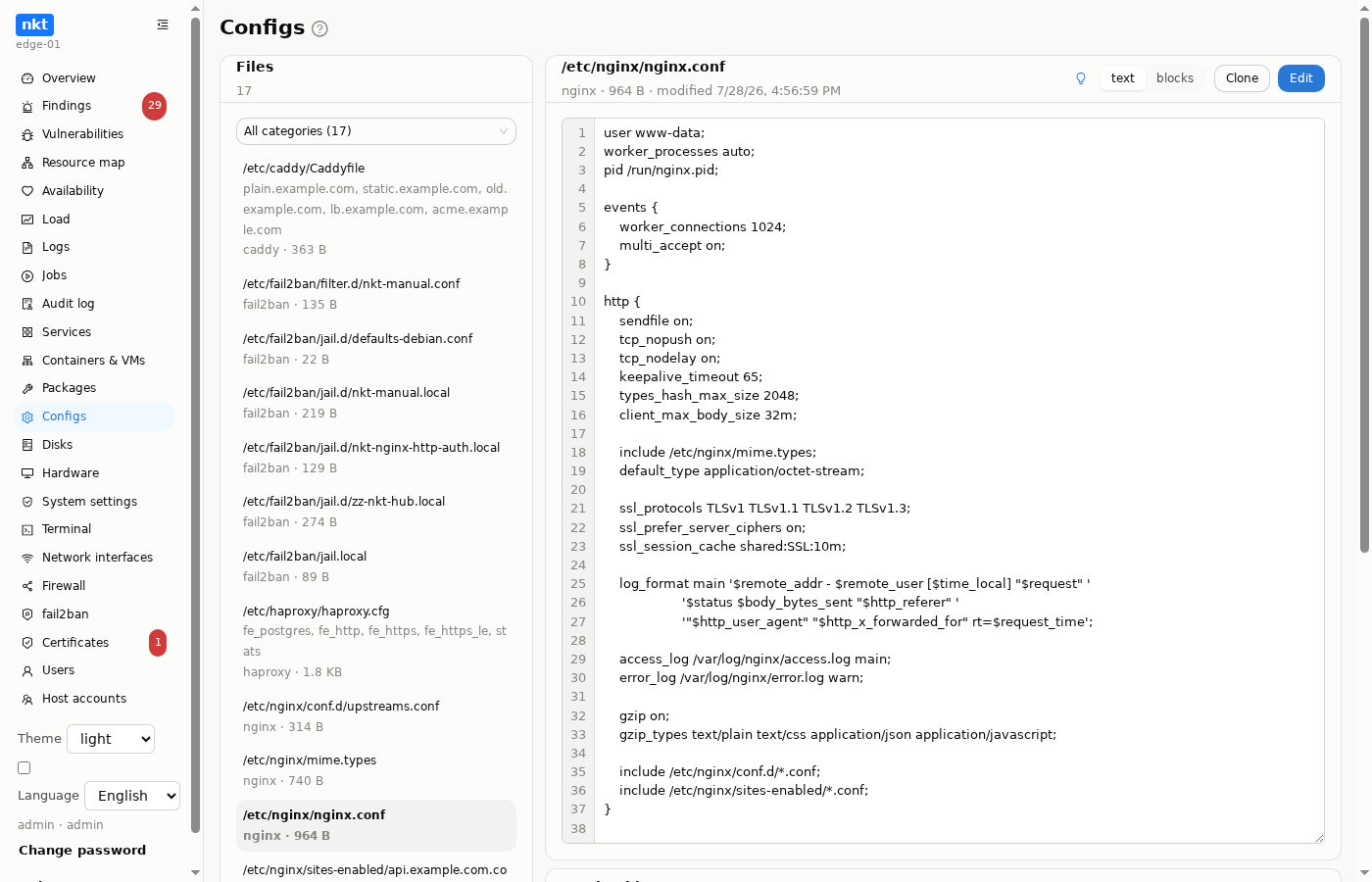
Every discovered config — nginx, haproxy, caddy, docker compose, systemd, cron, sshd, netplan, libvirt — by category; a finding in “Findings” jumps straight to the line.
Editor
- Line numbers, a change note, a “reload the service after saving” switch.
- The written config is checked by the service itself right away (
nginx -t,haproxy -c,docker compose config -q,virt-xml-validate…). If the check fails, the file is automatically restored to its previous state, and the service does not reload it. Files with nothing to check them are written without a check. - Apply after writing:
reload/restartof the service,docker compose up,virsh define— with a check as well; netplan is checked withnetplan generateand applied by hand, so you do not lose the network. - sshd protection: before writing, nkt checks whether you would still get into the host if sshd failed to come up; after writing — that sshd accepts connections, otherwise rollback.
- A new file — in the category's directory; writing to directories outside the systemd sandbox offers “Allow writes” (a
ReadWritePathsdrop-in and a service restart).
Version history
Every save is a version with an author and a note. Any one can be viewed, compared with the current one (unified diff) and rolled back to; the rollback is checked by the service as well.
Editing
The file on the page is read-only. "Edit" opens a window: the editor, a note for the edit, "apply" (reload the service), "show changes" and a "History" tab — versions, a diff of any of them against the current one, rollback. "Save" first shows the diff "on disk → draft"; only "Write" writes, with the configuration check and a rollback on failure.
Block mode
nginx, haproxy, caddy, compose files and machine XML have blocks: a tree of server/location/upstream, frontend/backend/listen, site, for compose — service, network, volume, secret, config, for a machine — settings and devices (disk, interface, graphics). A block is added (+ with a template), edited and deleted on its own — without the risk of breaking its neighbours; a diff "on disk → after the edit" is shown before writing, and the write is validated and rolled back on failure.